
Employment Law Services for Employers in Ontario
Practical legal advice on terminations, contracts, workplace investigations, human rights, and employment disputes — so you can make confident decisions and manage risk.
Most employers don’t think about employment law until something has already gone wrong. A termination that gets challenged. A workplace complaint that escalates. An employment contract that was not drafted carefully and now it matters.
Ontario employers carry real legal obligations at every stage of the employment relationship. Whether you need an employment lawyer in Toronto to review your employment contracts before you sign them, or legal services for employers already facing a dispute, Bune Law gives you direct access to experienced legal guidance and representation for your business.
Sezar Bune has spent his career advising Ontario employers of all sizes on the employment law issues that come with running a company. He has helped employers with terminations, workplace investigations, human rights complaints, employment contracts, and disputes at every stage, before and after problems arise. That experience shows up in practical advice you can actually act on.
What Ontario Employers Are Often Not Told
Employment law risk rarely arrives with advance notice. It shows up in the gap between what an employer believed was legally sound and what Ontario courts and tribunals actually require. Here is what consistently catches Ontario employers off guard, often after a claim has already been filed.
Your employment contracts may not protect you the way you think
Termination clauses that were standard practice five years ago may not hold up in court today. Contracts carried over from other provinces, built from online templates, or left unchanged after a significant role change can leave your business exposed. Ontario courts have voided termination clauses on technical grounds — and when that happens, the cost goes up considerably.
How you handle a termination matters as much as the decision to terminate
What you say in that meeting, what goes in writing, and how quickly a severance package is presented all affect your legal risk. A dismissal that was defensible on the merits can become far more costly because of how it was carried out.
A resignation does not always end your legal exposure
Constructive dismissal — where an employee leaves because of significant changes to their role, pay, or working conditions — can produce claims comparable to a wrongful dismissal. Employers who restructure, reduce compensation, or allow a workplace to deteriorate without legal guidance often face claims they did not see coming.
Ignoring a harassment complaint creates more risk, not less
Ontario's Occupational Health and Safety Act requires every employer to have a workplace harassment policy and to investigate complaints properly. That obligation is not optional, and failing to meet it can trigger liability under multiple legal frameworks at once.
Human rights obligations apply to every Ontario employer, regardless of size
The duty to accommodate employees with disabilities, family status obligations, and protections against discrimination on other grounds apply whether you have five employees or five hundred. The cost of getting this wrong includes compensation for injury to dignity, on top of any other damages.
Which Situation Applies to You?
Employer legal matters tend to fall into two categories: those that can be addressed before a dispute arises, and those that require legal guidance because one is already in motion. Bune Law works with Ontario employers on both.
Employment Contract Drafting
Contracts with outdated or missing termination clauses are a primary source of employer liability in Ontario. We ensure your agreements are robust and enforceable before they are tested.
Employment Contract Drafting →Terminating an Employee
How a termination is handled — including what is written and offered — determines your legal exposure. We provide the strategy needed to minimize wrongful dismissal risks.
Termination & Severance Guidance →Wrongful Dismissal Defence
Early legal advice gives you an accurate picture of your exposure and a clear defence strategy before a situation escalates into costly litigation.
Wrongful Dismissal Defence →Human Rights Complaint Defence
These complaints carry specific legal obligations. We help employers respond quickly and effectively to resolve harassment or discrimination claims under the Human Rights Code.
Human Rights Defence →Constructive Dismissal Defence
When an employee claims their resignation was effectively a dismissal due to changes in their role or working conditions, the facts and timing matter. We help employers assess exposure and respond strategically.
Constructive Dismissal Defence →Workplace Harassment Defence
Facing a workplace harassment complaint requires a structured response. We help employers conduct proper investigations, manage the process, and implement clear procedures to protect the business and resolve matters efficiently.
Workplace Harassment Defence →Additional Employment Law Services
What Proactive Legal Guidance Actually Costs and What It Saves
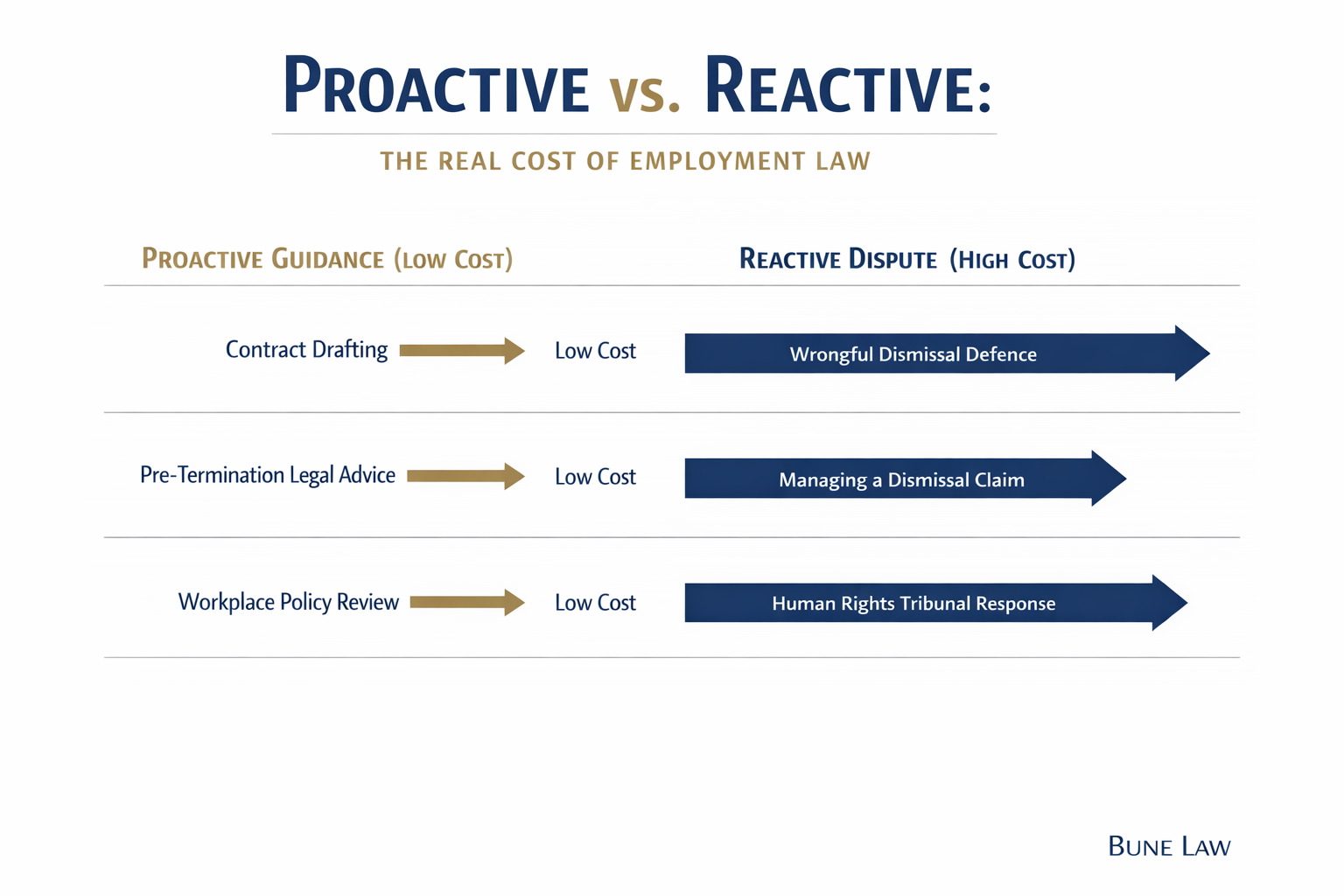
Employment law disputes often cost more to resolve than they do to prevent. An up-to-date, properly drafted termination clause costs a fraction of what employers pay when a court finds it unenforceable. The same logic applies before a termination: getting legal advice on the process costs a fraction of managing the wrongful dismissal claim that follows when it is not handled correctly.
The pattern is familiar. An employment contract that had not been reviewed in years. A termination that seemed routine and led to a wrongful dismissal claim. A demotion, temporary layoff, or pay cut that became the basis of a constructive dismissal claim.
Sezar Bune has seen it enough times to know: for any business with employees, the best time to get legal advice is before you need it.
Bune Law works with Ontario employers at every stage, before disputes arise and when they already have. If you want to get ahead of an employment law issue, or you are already dealing with one, contact us directly to discuss your situation.
Why Employers Across Toronto and the GTA Work With Bune Law
Employers facing employment law matters need something specific from legal counsel: a lawyer who understands not just the law, but how the other side thinks, what they are likely to argue, and where the real exposure lies.
Since 2014, Sezar Bune has represented both employees and employers in employment and civil litigation matters, including at a premier employment law firm in downtown Toronto. Having built and defended wrongful dismissal, constructive dismissal, and human rights claims, Sezar understands precisely how those claims are constructed, what evidence courts focus on, and where employer conduct creates the greatest vulnerability.
That perspective informs every employer file at Bune Law — whether the matter involves drafting contracts that will hold up, managing a termination correctly, or responding to a claim that has already been filed. The most avoidable employment law problems are rarely avoided because no one identified them early enough. That is what early legal guidance is for.
Every matter is handled personally by Sezar Bune. There is no handoff to junior staff — the lawyer you speak with is the lawyer who handles your file through to resolution.
Frequently Asked Questions
There is no legal requirement to obtain legal advice before terminating an employee, but the cost of not doing so can be considerable. The amount of notice or severance required, whether an employment contract's termination clause is enforceable, and how the termination is communicated all carry legal implications that are not always obvious without legal guidance.
Employers who obtain advice before a termination are better positioned to manage the process correctly and to limit their legal exposure from the outset.
Ontario employment law evolves, and termination clauses in particular have become one of the most actively litigated areas of employment contract law in the province. A clause that was considered standard practice several years ago may not meet current Ontario legal standards, and what qualifies as enforceable has, in practice, become something of a moving target.
Ontario courts have repeatedly found termination clauses unenforceable on grounds that were not anticipated when those clauses were drafted, leaving employers exposed to common law reasonable notice obligations they believed they had validly limited. A contract review can identify which provisions remain defensible and which warrant attention before a dispute arises.
Under Ontario's Employment Standards Act, 2000, termination pay and severance pay are two distinct statutory entitlements. Termination pay, or pay in lieu of notice, is owed to most employees upon dismissal based on length of service. Severance pay is a separate entitlement that applies only where an employer has a payroll of $2.5 million or more, or where 50 or more employees are dismissed within a six-month period.
Both represent the statutory floor. Where no enforceable termination clause exists, common law reasonable notice, which courts determine based on the specific facts of the employment relationship, may exceed these statutory minimums by a considerable margin.
A workforce restructuring involving multiple terminations requires careful planning, both to ensure compliance with Ontario's statutory requirements and to manage the legal risk associated with each individual termination. For each affected employee, the first question is whether an employment contract is in place and whether its termination clause is enforceable.
Where 50 or more employees are terminated within a four-week period, mass termination provisions under the Employment Standards Act, 2000 may apply, triggering additional notice requirements and procedural obligations. Obtaining legal advice before a restructuring, not in the middle of one, is what gives employers the clearest picture of their obligations.
The first step is to obtain legal advice promptly, before responding to the complaint or taking any further steps in relation to the employee involved. Human rights complaints filed with the Human Rights Tribunal of Ontario carry specific procedural requirements, and the employer's response, including any investigation steps taken, will be scrutinized carefully by the Tribunal.
Acting without legal guidance at this stage, even with good intentions, can create additional exposure. Early advice allows an employer to understand the nature of the complaint, assess what obligations arise from it, and develop a response that addresses those obligations properly from the outset.
Speak Directly With a Toronto Employer-Side Employment Lawyer
Building the right legal foundation, managing an active workplace situation, and responding to a claim that has already been filed all require the same starting point: a clear, accurate picture of your legal position before making decisions that are difficult to undo.
Employment law obligations do not pause while a business is focused elsewhere. The employers who avoid costly disputes are those who address legal risk before it becomes one.
Contact Bune Law today to speak directly with Sezar Bune about your employment law matter in Toronto, North York, or anywhere across the GTA and Ontario.
Request a Case
Assessment
Speak directly with Sezar Bune. No junior associates. No handoffs.